Why Scientists Predicted the End of Humanity on Friday November 13th, 2026
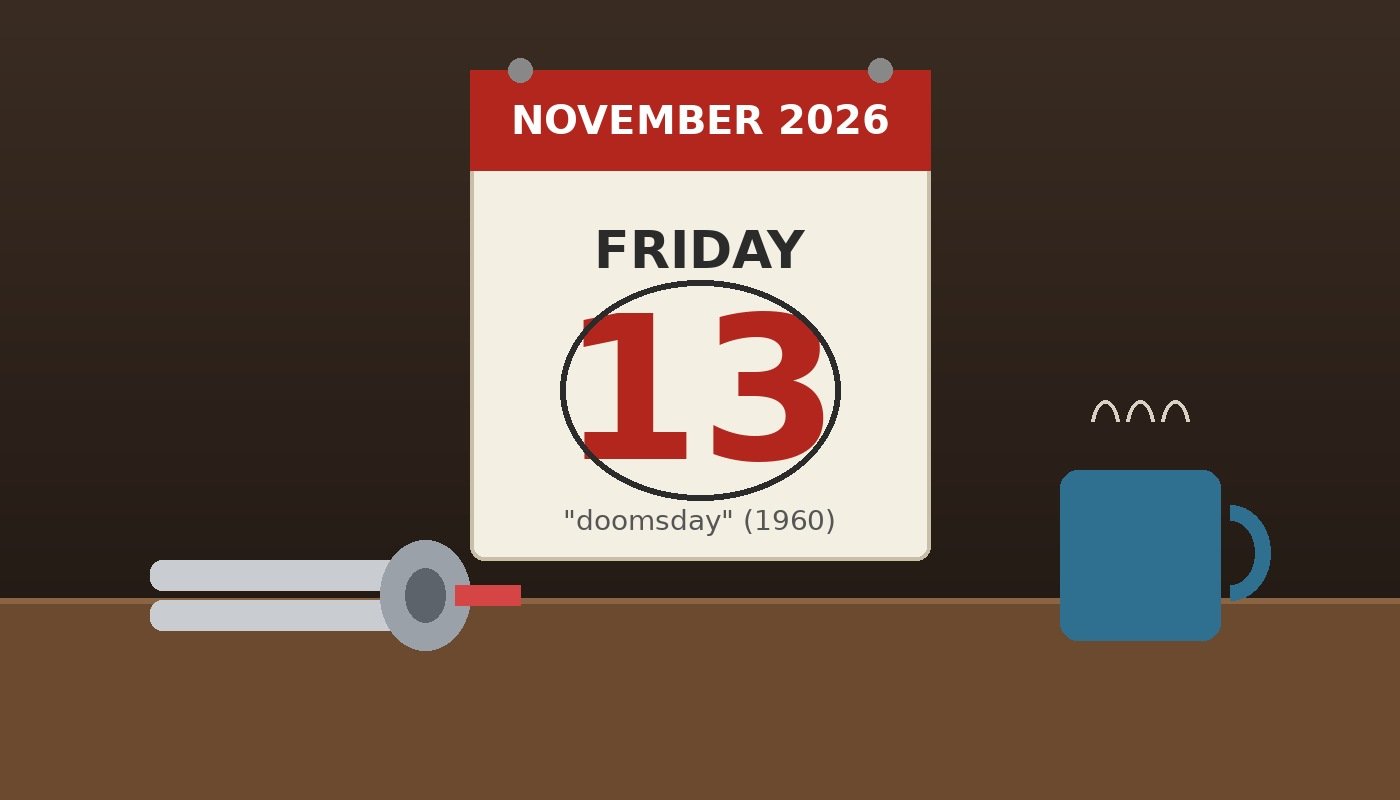
In 1960 a paper in Science put doomsday on Friday, 13 November 2026, the day human numbers would hit infinity.

Picture this: it's Friday morning, the coffee's on, the dog wants out, and somewhere in the kitchen drawer the humble can opener is sleeping soundly. Nothing about today feels like the end of the world.
But according to a paper in one of the most respected science journals on Earth, today is the day. Friday, 13 November 2026. Doomsday. Not a guess from a man on a street corner with a cardboard sign. A date worked out with equations, published in *Science* in 1960, and argued over by serious people for sixty-six years.
So pour yourself a cup, friend. Let's talk about why scientists predicted the end of humanity for this very morning, and why you're still here to read about it.
The paper with the scariest title in science
On 4 November 1960, *Science* published "Doomsday: Friday, 13 November, A.D. 2026" by Heinz von Foerster, Patricia Mora and Lawrence Amiot. According to *Science*'s own look back at the paper last month, all three were in the department of electrical engineering at the University of Illinois. Von Foerster was an Austrian-American physicist and one of the founding minds of cybernetics.
The New York Times ran it the same day: "A physicist has put a definite date on Doomsday."
Here's the thing that surprises people. The paper never said a comet was coming. It didn't say we'd run out of food, or water, or beans. It said something stranger.
The formula that pointed at today
Most living things grow in a way biologists can model. Put fruit flies in a jar and their numbers climb fast, then level off when the jar gets crowded.
Von Foerster's team argued that people aren't fruit flies. We talk, we team up, we share ideas. More people means more brains on the problem: better farming, better medicine, better plumbing. So instead of slowing down as we multiply, our growth rate itself had been speeding up.
They gathered 24 estimates of world population going back roughly two thousand years, up to 1958, and fitted a curve. The result was a formula you could write on a napkin:
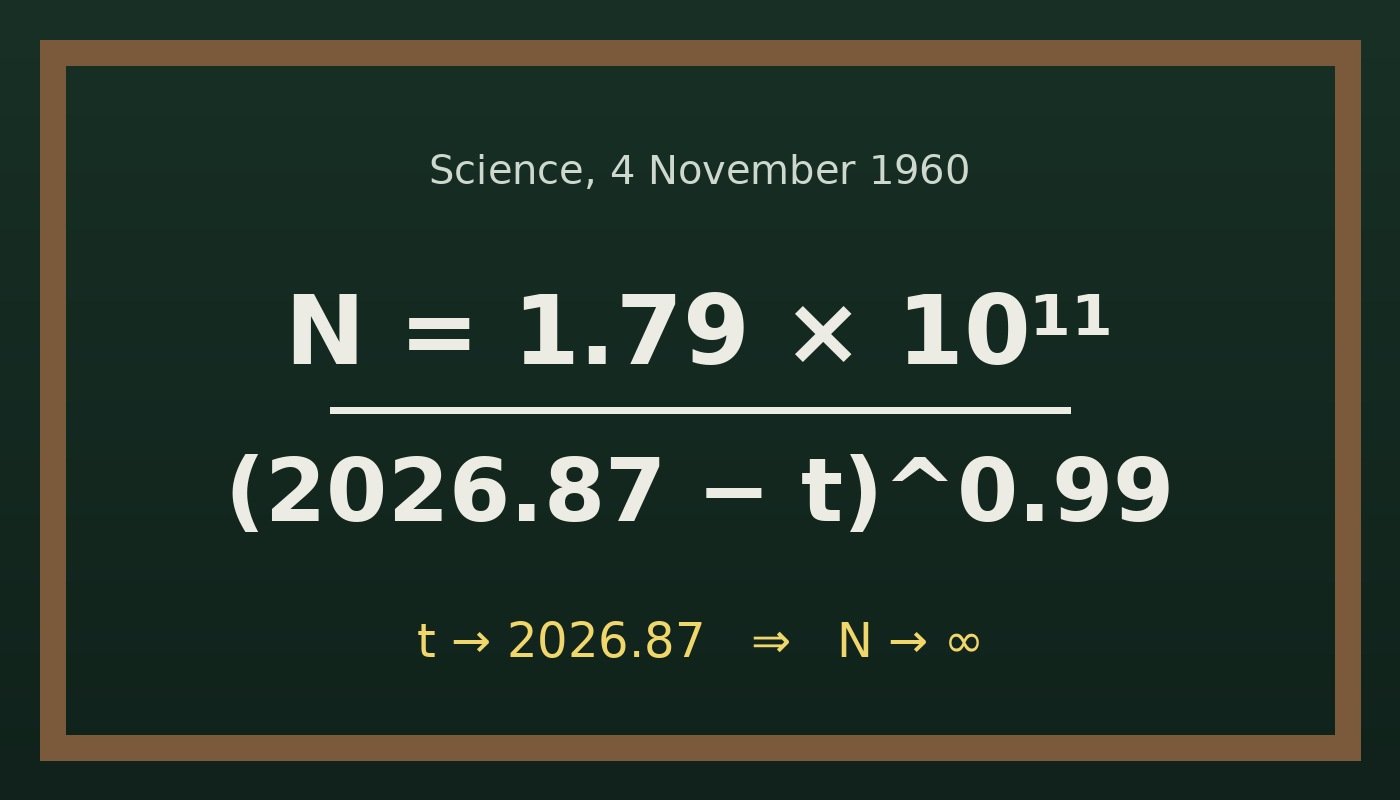
N = 1.79 × 10¹¹ ÷ (2026.87 − t)^0.99
N is the number of people. t is the year. Now look at the bottom of that fraction. As the year creeps toward 2026.87, the bottom shrinks toward zero, and the number of people shoots toward infinity. Mathematicians call that a singularity. Von Foerster called it doomsday, the date when, in the paper's words, "the clever population annihilates itself."
And then came the line that got everybody's attention: "Our great-great-grandchildren will not starve. They will be squeezed to death."
Why Friday the 13th?
The maths actually landed on 2026.87, give or take five and a half years. *Science* reports that von Foerster went looking in the middle of that window and found a Friday the 13th sitting conveniently in November 2026. It also happened to be his birthday. Today would have been his 115th, as The Conversation points out.
So yes, the man picked a spooky date on purpose. I'm a former playwright. I respect a man who knows how to name a show.
The scary part: it worked for a while
Demographers hated the paper. Harold Dorn wrote in *Science* in 1962 that the forecast would set a record "for the short length of time required to demonstrate its unreliability."
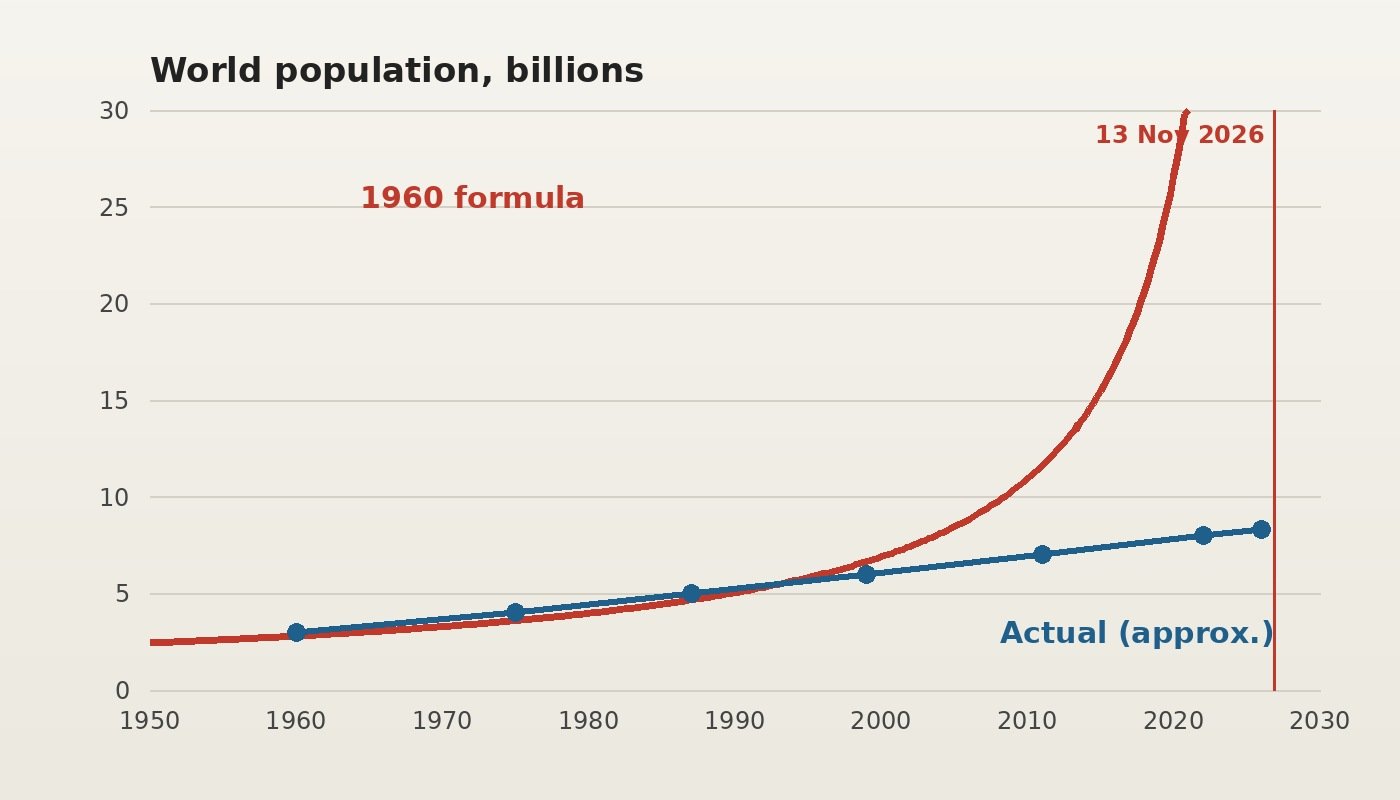
Then the numbers kept coming in. The formula says about 3.6 billion people by 1975. The real figure, *Science* notes, was about 4 billion, even more than the formula predicted. According to The Conversation, the curve tracked reality remarkably well until around 1993.
I can only imagine the family dinners in 1975. "Pass the potatoes. And did you hear the doomsday guy is right so far?"
Why it didn't happen
Then the real world turned off the formula's highway.
Run the formula forward and you get about 6.9 billion people in 2000, about 10.9 billion in 2010, and more than 26 billion by 2020. What we actually got, per *Science*: closer to 6 billion in 2000, 7 billion in 2010, and a little over 8 billion today. Not infinity. Not even close.
What happened? People did something no curve-fitter can see coming. As child deaths fell and families moved into towns and cities, parents chose to have fewer children. The demographers' name for it is the demographic transition. Your grandma might just call it common sense.
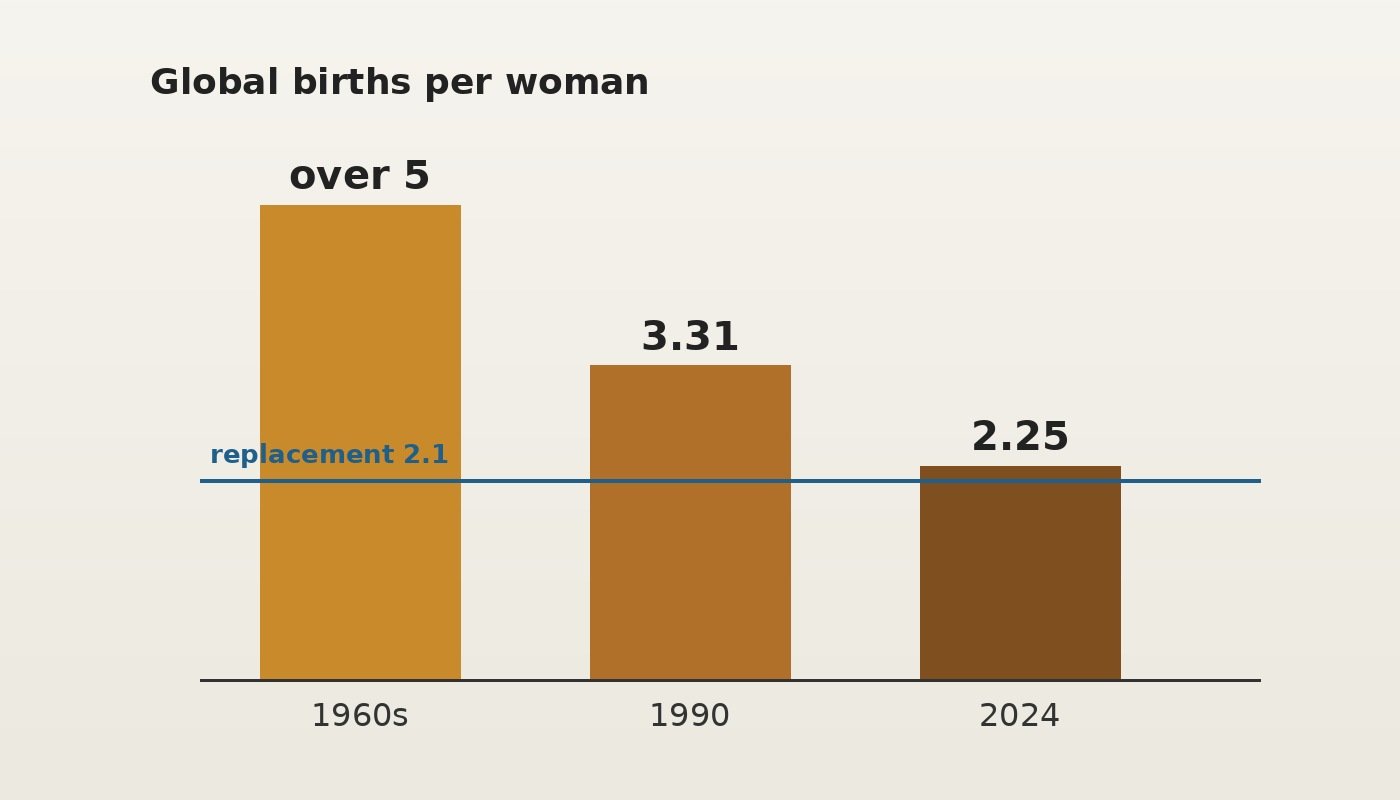
According to Our World in Data, the global fertility rate has more than halved since the 1960s, from over five children per woman to about 2.3.
Economist Javier Birchenall put it neatly in *Science*: the failure of the formula is "a cautionary tale about the dangers of extrapolating from historically exceptional circumstances." In plain Texan: the past is a great teacher and a lousy fortune-teller.
To be fair to the professor, he may not have meant it literally. The authors themselves said they wanted to "add some fuel to the heated controversy" over population growth. Population biologist Joel Cohen told *Science*: "I don't think [von Foerster] was seriously trying to predict the future."
The twist: the real story is fewer babies
Here's the irony I can't get over.
In 1960, the fear was too many people. In 2026, the headlines are about too few.
The UN's World Population Prospects 2024 projects that world population will peak at around 10.3 billion in the mid-2080s, then slowly decline to about 10.2 billion by 2100. The UN puts the chance of a peak this century at 80 per cent. The global fertility rate is now 2.25 births per woman, down from 3.31 in 1990. More than half of all countries are below the 2.1 needed to keep a population steady without migration. Nearly a fifth, including China, Italy, South Korea and Spain, are below 1.4.
The Conversation notes that the world's number of under-15s peaked in 2021, and that countries such as Japan, Hungary, Turkey and China are now encouraging couples to have more children.
So the doomsday that was supposed to squeeze us to death turned into a world wondering who'll look after Grandpa. Nobody's formula saw that coming either.
What a prepper takes from this
I've written a lot of Doomsday Prepping guides, so let me be the first to say it: today is a great day to check your water, not to panic.
The lesson from von Foerster isn't "ignore warnings." It's this:
- Trends bend. A line that has gone up for two thousand years can still turn. Plan for what's likely, not just what's scary.
- People adapt. Humans changed their own behaviour and broke the scariest formula in science. That's the best news in this whole story.
- Real resilience is boring. Water, a week of food, a torch, a plan the whole family knows. None of it depends on whether a prediction comes true.
So if anyone at work today says it's the end of the world, smile, hand them a coffee and tell them about the professor who picked his own birthday for doomsday.
Then go home, check the pantry, and make sure the can opener still works.
Every sunrise is a victory. And this Friday the 13th, friend, we're still here to see it.
And Remember:
Trust no Single Source
Trust Your Gut
and Stay Curious
J-Mark
For media enquiries, please contact:
UK - 020 3404 2295
USA - 0650 702 7445
AUS - 02 9072 9499
Help Support J-Mark and the rest of our Authors by visiting the store to get your copy of the latest Anonymous Author Novel or Anything Anonymous.