Why Not Now? They Promise AI Will Make Us All Rich
Tech leaders promise AI will bring extreme wealth, superhuman healthcare and the end of disease. Sally Joe asks why, with trillions already sitting in the same hands, we are told to wait.
I don't know about you, but I'm getting tired of being told to wait.
Wait for the intelligence. Wait for the robots. Wait for the "gentle singularity". Wait until scarcity itself becomes a lifestyle choice. Then — and only then, apparently — the people who already own the future will let the rest of us have a slice of it.
Healthcare. Education. A bit of dignity that doesn't depend on a food bank. Not yet, love. The algorithm isn't quite ready.

The sermon of abundance
The sales pitch is not subtle. It comes from the same small circle of men who are building the systems and collecting the shares.
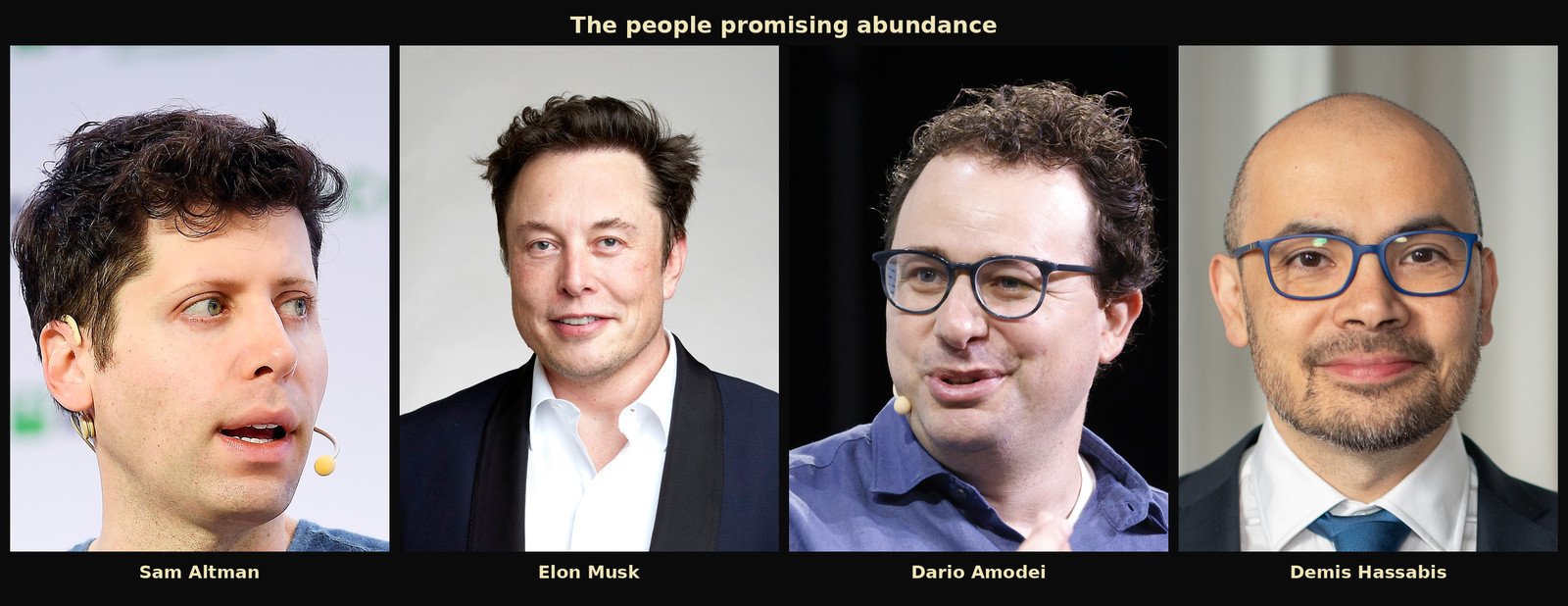
In March 2021, OpenAI's Sam Altman wrote that the AI revolution "will generate enough wealth for everyone to have what they need, if we as a society manage it responsibly." He sketched an "American Equity Fund" that might one day send every American adult about $13,500 a year. In 2025, in "The Gentle Singularity", he said intelligence and energy are "going to become wildly abundant". With those, "and good governance, we can theoretically have anything else." By last summer he was talking about "universal extreme wealth for everybody". Then, this April, he told The Atlantic he no longer believed in universal basic income as much as he once did. The slogan moves. The instruction does not. Wait.
Elon Musk has been even blunter. On Christmas 2023 he wrote that a "positive AI future" would bring "universal high income, not basic". "No scarcity, except that which we define to be scarce." Everyone, he said, could have "whatever goods & services they want." In November 2025 he posted that the most likely outcome is that AI and robots "make everyone wealthy. In fact, far wealthier than the richest person on Earth", with "medical care that is superhuman" thrown in.
Anthropic's Dario Amodei, in his October 2024 essay "Machines of Loving Grace", predicted that AI-enabled biology could compress fifty to a hundred years of medical progress into five to ten — a "compressed 21st century" with "reliable prevention and treatment of nearly all natural infectious disease" and the "elimination of most cancer".
And Demis Hassabis, who runs Google DeepMind and already has a Nobel Prize for work on the proteins of life, told CBS's 60 Minutes in April 2025 that "maybe we can cure all disease with the help of AI." The end of disease? "I think that's within reach. Maybe within the next decade or so, I don't see why not." He calls the wider prize "radical abundance."
I am not going to pretend those people are stupid. Some of this may even come true. AlphaFold is real. The disease work is not a joke.
The question is not whether the science is exciting. The question is who is holding the spoils while we wait — and why "not yet" is the answer we keep being given when we ask for the basics now.
Follow the money
Because the money, just to be clear, is already here. It is not waiting for a breakthrough. It is concentrated, and being spent at a scale that would make a chancellor's eyes water.
In January, Oxfam reported that billionaire wealth jumped more than 16 per cent in 2025, to $18.3 trillion — an 81 per cent rise since 2020. In a single year those fortunes grew by $2.5 trillion, almost as much as the total wealth of the bottom half of humanity, some 4.1 billion people. Oxfam says that one-year rise would be enough to eradicate extreme poverty twenty-six times over. Elon Musk, it noted, had become the first person to surpass half a trillion dollars. By the time Forbes published its 2026 billionaires list, using prices from 1 March, there were 3,428 of them, worth a combined $20.1 trillion — $4 trillion richer than the year before.
Now look at what the companies themselves are prepared to spend. After their late-October earnings, Amazon, Microsoft, Alphabet and Meta told investors they plan at least $720 billion of capital expenditure this year, most of it on AI infrastructure. Amazon alone is aiming at $220 billion.
I will be fair. Capital expenditure is not a pile of cash sitting in a drawer, waiting to be posted to a hospital. A lot of it is concrete, silicon and electricity. Some of it is borrowed. It does not convert, pound for pound, into nurses' pay.
But look at the scale. These firms can already mobilise, in a single year, a sum that — even allowing for the exchange rate — comes to more than two years of NHS England's day-to-day budget, which The King's Fund puts at £198 billion for 2025/26. They can afford a buildout of this size now. We are told we cannot afford the basics now. That is a political choice, dressed up as a timetable.
And tax? I want to be careful here. Economist Gabriel Zucman has estimated that billionaires pay, in tax, around 0.3 per cent of their wealth each year. That is not a nurse's income-tax rate. Most of a billionaire's gain sits in shares that have not been sold. You generally do not pay income tax on a share you haven't sold. Meanwhile a nurse, a teacher, a warehouse worker, pays income tax and National Insurance on every payday. Different rules. Same country.
The stock market, for those who already own the stock, has been a machine for making those fortunes fatter — not least on the back of the AI boom. For everyone else it is often just the thing their pension is exposed to, while prices at the till keep rising. I'm not asking you to smash the market. I am asking you to notice who it is built to reward.
We've heard this sermon before. Globalisation and free trade were going to lift everyone. Trickle-down was going to lift everyone. Cut taxes at the top — Reagan, Thatcher, and a long line after them — and the proceeds would work their way down. They didn't. A 2020 study by David Hope and Julian Limberg, at the LSE and King's, looked at fifty years of major tax cuts for the rich across eighteen OECD countries. Those cuts raised the top 1% share of pre-tax national income by about 0.8 percentage points. They had no significant effect on growth or unemployment.
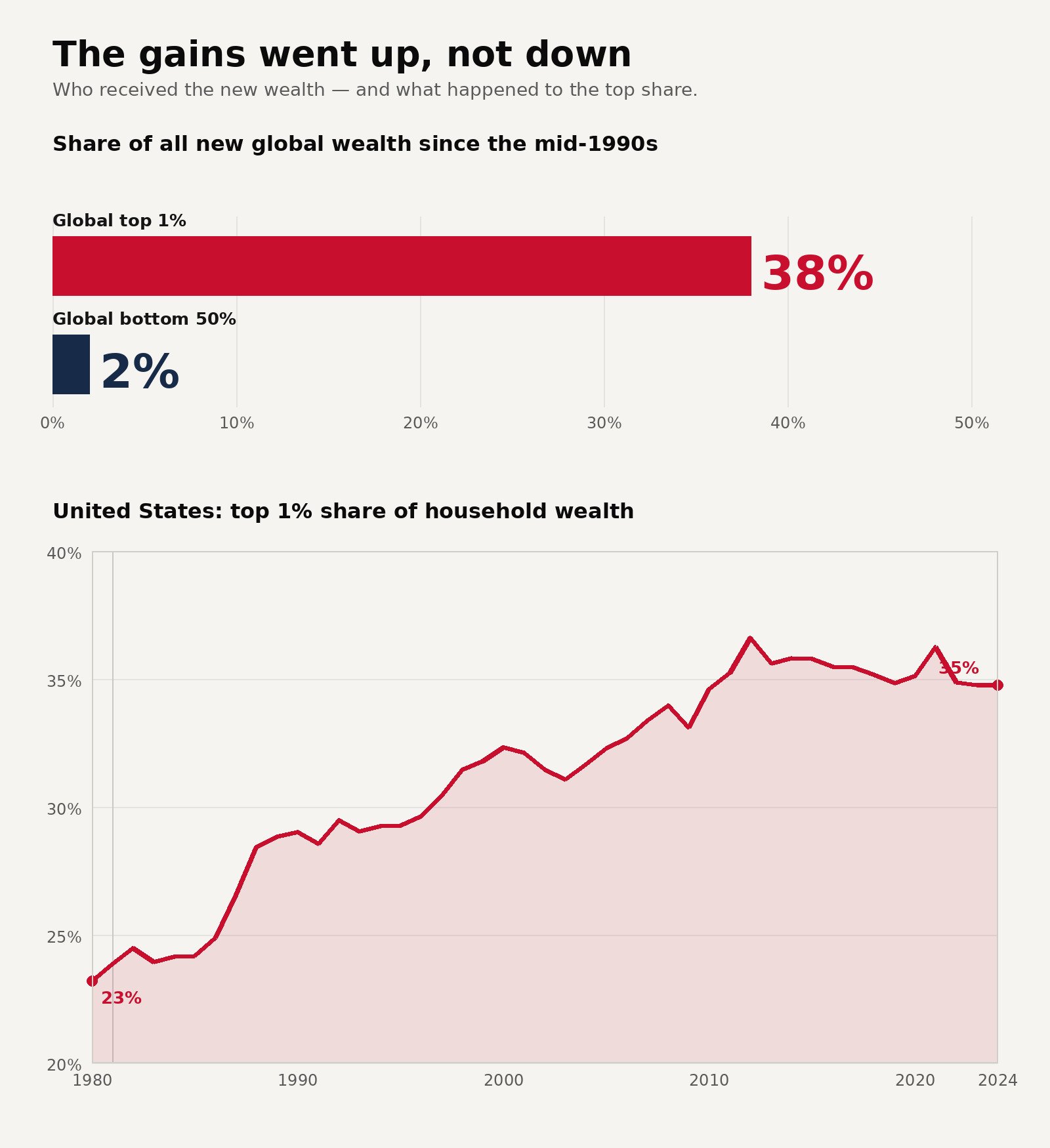
The World Inequality Database tells the same story in a different key. Since the mid-1990s, the global top 1% has captured 38% of all the new wealth in the world. The bottom half of humanity captured 2%. In the United States, the top 1% share of household wealth rose from about 23% in 1980 to about 35% by 2024. The promise keeps changing its name. The direction of the money does not.
What we could do now
Let's talk about a Tuesday, not a hypothetical future.
The King's Fund, updating its figures on 2 November, notes that planned NHS spending is due to rise by an average of only 1.3 per cent a year in real terms through to 2028/29 — below the historic average. You do not need a lecture from me about what that feels like in a waiting room in Nottingham, or the practice that can't fill a GP slot. My mum waited months for treatment and was let down by the communication, not by the nurses. I still love the nurses. I still get angry.
A core schools budget of £65.3 billion is not nothing. It is a decision, made in Westminster, about priorities. The same is true of social care, and of the hole in local-authority funding.
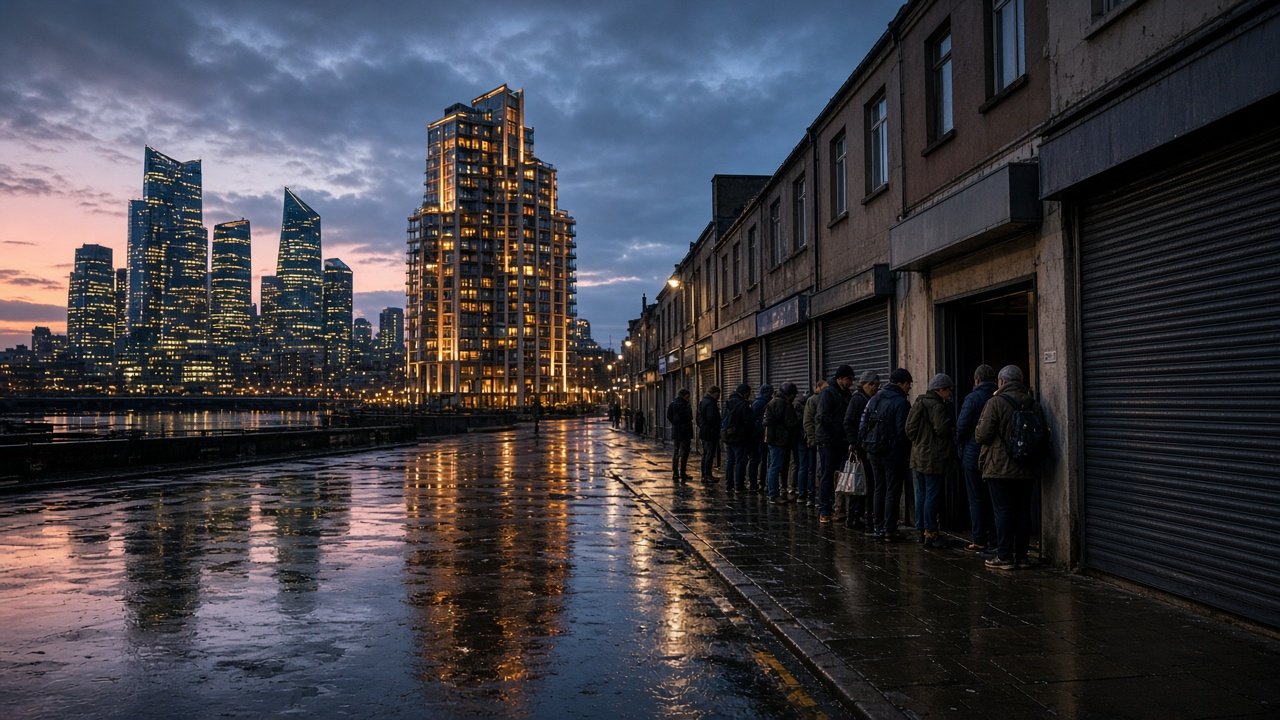
I am not calling for a fairy tale. I am saying that if a society can find $720 billion a year to race-build the future, it can also choose, now, to tax extraordinary wealth more seriously and put nurses and teachers ahead of another sermon about tomorrow.

Why not now?
Here is my position, plainly.
I am not anti-AI. I have used the tools. I can see the medical promise, and I would be a fool to sneer at a cancer breakthrough because I don't like the man who funded the lab. What I am against is the idea that ordinary people must sit tight, accept the waiting list and the crumbling classroom, accept "we can't do that at the moment", while the people making the promises spend like a state and accumulate like a dynasty.
If the technology can one day cure disease, fund a high income, and usher in radical abundance, wonderful. Start sharing the proceeds as they arrive, not after the share price has done another lap. Tax the fortunes that have already been made — including on the back of this boom — at a level that actually bites. Fund healthcare properly. Fund education properly. Make the billionaires pay, not as a slogan, but as a line in the budget. You do not need a superintelligence to do any of that. You need a spine.
"No, we can't help you now." That's the line, isn't it? From governments, from corporate spokespeople, from the quietly reasonable voice that says the books won't allow it. The books allowed a $720 billion infrastructure race. The books allowed $20.1 trillion to gather in a few thousand pairs of hands. The books, it turns out, are quite flexible when the right people are asking.
We could move, right now, toward a society that is a bit more interested in the many than in the few — call it socialist-ish if you like, I call it fair. Better healthcare. Better schools. A tax system that does not treat a warehouse wage as more real than a billion-dollar paper gain. Not because a chatbot promised us a castle. Because we already have the means, and we can already see who has them.
Wait for the robots, if you want.
I'm done waiting for permission to help people.
Same money. Same excuses. Same delay.
The abundance can wait. The waiting rooms shouldn't.
And Remember:
Trust no Single Source
Trust Your Gut
and Stay Curious
Sally Joe
For media enquiries, please contact:
UK - 020 3404 2295
USA - 0650 702 7445
AUS - 02 9072 9499
theanonymouspublishinghouse@gmail.com
Help Support Sally Joe and the rest of our Authors by visiting the store to get your copy of the latest Anonymous Author Novel or Anything Anonymous.